Posts

Showing posts with the label hydroulic chuck power chuck stationery chuck ubl chuck

The Top Uses for a Manual Indexing Chuck in Machining and Fabrication

 In the world of machining and fabrication, precision and efficiency are key. One essential tool that helps achieve these goals is the manual indexing chuck. This versatile device allows for accurate and repeatable positioning of workpieces, making it an invaluable asset in various machining operations.   1. Drilling and Tapping Operations Drilling and tapping are common machining processes that require precise positioning and alignment of the workpiece. A manual indexing chuck ensures that the holes are drilled or tapped at the correct intervals and angles, reducing the chances of errors and rework. With its ability to rotate and lock the workpiece in place, the manual indexing chuck significantly improves the accuracy and efficiency of these operations.   2. Milling Operations Milling operations involve cutting and shaping materials using a rotating cutting tool. The manual indexing chuck is particularly useful in milling applications, as it allows for prec...
Understanding the Components of a CNC Power Chuck

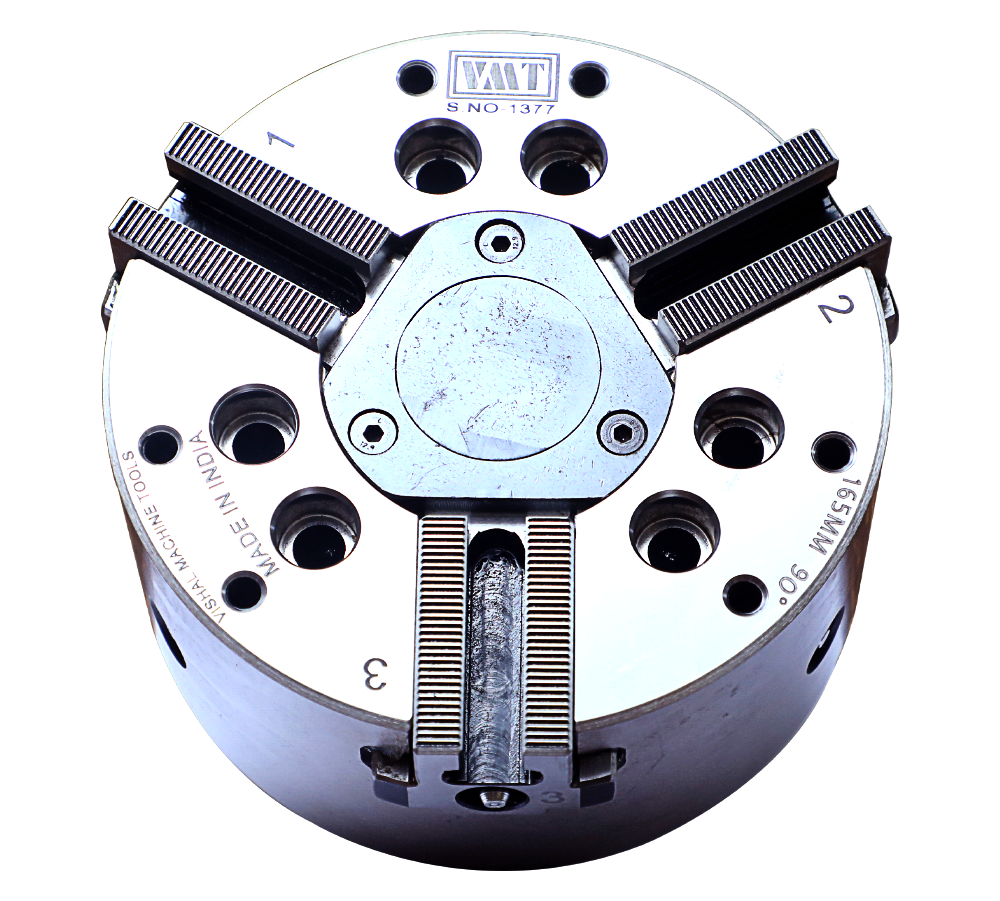
  CNC machines require a power chuck to hold the workpiece. The power chuck provides a stable location for the workpiece, which allows for greater accuracy during milling or drilling tasks. Several components are part of a  CNC power chuck , each important in how well it functions. In this article, we'll discuss these components and how they impact your machine's performance:   The outer race   The chuck's outer race is the component affixed to the equipment. It's made of hardened steel and held in place by a parallelism sleeve and shaft seat. It provides strength and rigidity when installed properly.   The inner race   The inner race is one of the most important components of your  CNC power chuck , and it serves several functions. The inner race is to hold the spindle in place while you're machining. It also supports other parts, like bearings and seals, which help with lubrication and heat transfer from friction during operation. ...

Maximizing Efficiency with UBL Chuck: The Key to Achieving Perfect Machining.

  Machining is shaping and finishing materials using various tools and machines. Machining requires precise and reliable work-holding devices that can clamp the workpieces securely and accurately. One of the most versatile and effective work-holding devices is the UBL chuck, which stands for Universal Ball Lock (UBL) Chuck. What is UBL Chuck? A UBL chuck is a power-operated chuck with some distinctive advantages over wedge and lever-type chucks. It consists of a base jaw, a wedge, a spherical aligner, a spherical bush, and a ball lock. The base jaw slides and swivels on the wedge, which is actuated by a hydraulic or pneumatic cylinder. The spherical aligner and bush allow the base jaw to adjust to the irregularities of the workpiece before applying full clamping force. The ball lock ensures positive locking of the base jaw in any position. How to Maximise Efficiency with UBL Chuck Using a UBL chuck can improve the efficiency and quality of machining in several ways. Here ...

Low profile chucks for your manufacturing unit.

  Machines may require several components to complete a task. Sometimes this requires a thinner than low profile component designed to hold a variety of items. If you're looking for low-profile clamping jaws to keep your machines running smoothly, then look for a reputable stationery chuck manufacturer in India that can deliver such a machine for your workspace.   REASONS TO USE BLANK PROFILE JAWS   Maintain productivity in your plant and beyond by incorporating low-profile chuck jaws into your operations. Due to their unobtrusive design, a low-profile UBL chuck is often used in applications with limited tool clearance. In addition, its design allows processing near the face of the chuck. This prevents thin parts from sinking or bending, making the whole process more efficient and less likely to drift by pinching broken parts. Although this option is lighter and has a lower profile than standard chucks, it has the same holding power. Its properties make it ideal...

Power Chuck Troubleshooting: Common Issues and Solutions.

Power chucks play a crucial role in machine tool applications, but like any mechanical component, they can experience issues. Understanding the common problems that can occur and how to troubleshoot them can help minimize downtime and maintain the performance of your power chuck. This article will discuss some of the most common power chuck issues and provide solutions to fix them. Additionally, we will highlight a reputable colletchuck manufacturer in India , United Barfeeds Limited (UBL), and their high-quality product, the UBL chuck .   Workpiece Not Holding Securely   One of the most common powers chuck issues is a workpiece not holding securely. Several factors, including worn jaws, loose or damaged clamping bolts, or incorrect jaw adjustment, can cause this.   Solution : To fix this issue, check the condition of the jaws and replace them if worn. Tighten or replace loose or damaged clamping bolts and check the jaw adjustment to ensure it is correct for your workpie...

Maximizing Efficiency with Power Chuck Upgrades

To maximize the efficiency of these tools, they need to be upgraded with a stationary power chuck or compensation chuck . This article will explore how such upgrades can help companies increase their overall production efficiency and save costs in the long run.   Power Chuck Upgrades   Power Chuck Upgrades are essential for maximizing efficiency in industrial applications. With the proper upgrades, a compensation chuck can help to provide smoother operation at higher speeds and more precision for more significant parts.   Advantages of Upgrading Power Chuck The first advantage of upgrading is increased speed and accuracy. Modernized power chucks with newer parts allow more torque to be applied when tightening, ensuring faster run times and higher precision when machining. This also helps reduce downtime due to mechanical issues and wear and tear on older parts, which could impede productivity. Additionally, newer power chucks often have improved cooling systems that ke...

Advantages and Uses of Collets – Vishal Machine Tools

  Do you want to know about 5C collets? Do you want to effectively control their tools? Then this guide will make the concept easier for you. In general, 5C collets are a popular standard for lathes and mills. Used to hold cylindrical material greater than 1″ (25mm) in diameter. Collet 5c provides exceptional concentricity to make setup easier than three jaw heads without any problems.   Advantages and features of 5C collets   The advantages and features of 5C collets are: • Unique steel for long life • Exact class • Tools Accessible • Paved and sanded • Inch and metric dimensions • Accessible workpiece stop and adjustable collet • Useful for most 5C and R8 devices.   Work on lathe collets   In general, a collet is a subtype of chuck that can easily form a sleeve around the workpiece. Then, after tightening, it exerts a strong clamping force on the object. This can be helped by tapping the outer collar. Finally, lathe collets are us...

Why and where should you use power chuck?

Image
A Power Chuck is ... The workpiece is held firmly in place by the power chuck's jaws (usually 3 or 4 jaws). The term stems from the fact that an automated power source generates the clamping force (electrical, mechanical, or other means). There are several benefits to using a work-holding method tailored to cylindrical objects with radial symmetry.   Advantages The effectiveness of a power chuck is unquestionably its most significant benefit. The Hydraulic chuck can now be clamped at a significantly faster rate thanks to the design, making it suitable for use in mass production. For high-volume manufacturing, manual clamping methods are prohibitively time-consuming. As a result, power chucks are the way to go when productivity is paramount.   Applications Power chucks are used in several modern machining techniques, such as drilling, milling, turning, clamping the workpieces, and holding the machine's tools. The following paragraphs will examine the role of power ch...

Difference between manual and hydraulic press.

Image
  The production speed of a mechanical press is one of its main selling points, while the adaptability of a hydraulic press makes it ideal for more intricate shaping tasks. We have put forth some points shared by  specially customizedchuck manufacturers in India   about the mechanism of these two machines to illustrate the distinction.   Mechanical Press Operation Principle   As per the information shared by the  collet chuck manufacturer ,  power in a mechanical press comes from, you guessed it, mechanical means. The primary motor is linked to a crankshaft and flywheel that alternately cycle the ram. A clutch regulates the motor in basic mechanical presses. The flywheel sets in action the pinion gear arrangement that turns the crankshaft into larger, more complicated press machines.   The flywheels collect momentum from the motor as it drives the central system and transmits via the transmission. When it comes to producing energy, lar...

When to Choose the Collet Chuck?

Image
 For most revolving center MT - 4 CNC machine lathe users, the three-jaw chuck is the common tool through which they fix the workpieces. This arrangement is highly flexible and is commonly used in numerous applications. However, if you look at it carefully, you will find that it is not perfect for all types of jobs.  If you talk to a reputable stationary power collet chuck manufacturer, he will suggest that collet is an alternative that you should look at to hold the workpiece more effectively. The collet uses mechanical power to hold the part that turns. While it is true that the capacity of the collet chuck is limited to the workpiece sizes, unlike the jaw chuck, it more than makes up for it in terms of accuracy, speed, and other productivity benefits. In addition to these, there are a few other factors that you have to weigh carefully to figure out which type of chuck will work perfectly in your work environment. Here we have together a list of some important factors t...

What type of Chuck is important for your company?

Image
  Collets are used for holding the bar stock. The collet is a round iron shell with three evenly spaced notches that extend most of its length. While plans change, all types of collets work by clamping the retainer, resulting in the same precise alignment and static grinding. These cuts give the pincer activity when jumping. That is why the collets are also called "spring-loaded collets". The nose of the collet is thicker to form the jaws. The outer surface of the nose matches the shape of the cap opening. The collet chuck manufacturer in India makes collet according to the work it has to do and the benchmark that is required to be followed. Collets are preferable in many manufacturing and large production jobs because they are quite easy to handle and are safe. Types of collet chucks include the following 1). Push Out Type Collet Chuck For this type of neck shape, the nose and hood are on the right side. To grip the workpiece, the sharpened part of the spring collet ...

Applications of a power chuck

Image
  Define power chuck It is a work-holding device that makes use of its jaw to keep a workpiece secure. The force that is used to clamp the workpiece is derived from an automated power source, hence the name power chuck. Such types of machines are designed mainly to hold objects which are cylindrical and have radial symmetry. According to a reputed power chuck manufacturer in India, such a machine has numerous advantages. Advantages of a power chuck machine   1). The most important advantage according to a well-known power chuck manufacturer in India of such a machine is its improved efficiency. The design of the machine is such that it allows the jaws of the chuck to quickly secure the workpiece. This is an ideal feature, especially when you are looking at high-volume production. If you are using a manual clamping approach in a large-volume production, then it will increase the time significantly. Therefore, businesses with large-volume production who are concerned...